and the GC has cleaned up all his debris and been paid his final check.
Yay! It’s all mine and I can do anything I want with it!
Hmmmm, time to start thinking about that hoist for the Wood Storage Loft…
and the GC has cleaned up all his debris and been paid his final check.
Yay! It’s all mine and I can do anything I want with it!
Hmmmm, time to start thinking about that hoist for the Wood Storage Loft…
I’ve managed to resurrect my Router table in the Workshop after thinking I’d have to replace it completely.
The reason I didn’t think I could use the old one was because I had previously used the extra area on the right side of my Table saw to house the Router table. This worked well in my previous shop since each piece of equipment (out of necessity) could be repositioned on mobile bases; rearranging to use the router table was trivial.
With my new set up, however, I have the equipment grouped in, more or less, fixed positions and, as you can see in the next photo, the right side of the Table saw is blocked by my Jointer.

Table Saw and Jointer grouping. The Router table top had been located between the two arms coming off the right side of the Table Saw.
Needing to do some routing for an upcoming project, I decided to try to re-use the top because I didn’t want to spend the time to build the new ‘ultimate’ Router table – yet, anyway.
After pulling out the old top, I realized that if I found a way to clamp it to the back of my workbench to give it strength and stability, then all I’d need to do was add some simple legs to keep the outer edge upright. After setting this up, I then realized that the old baffles I used to contain the wood chips for the Dust Collector ducting, could still be hung from the table. And Voila! Here you have it!
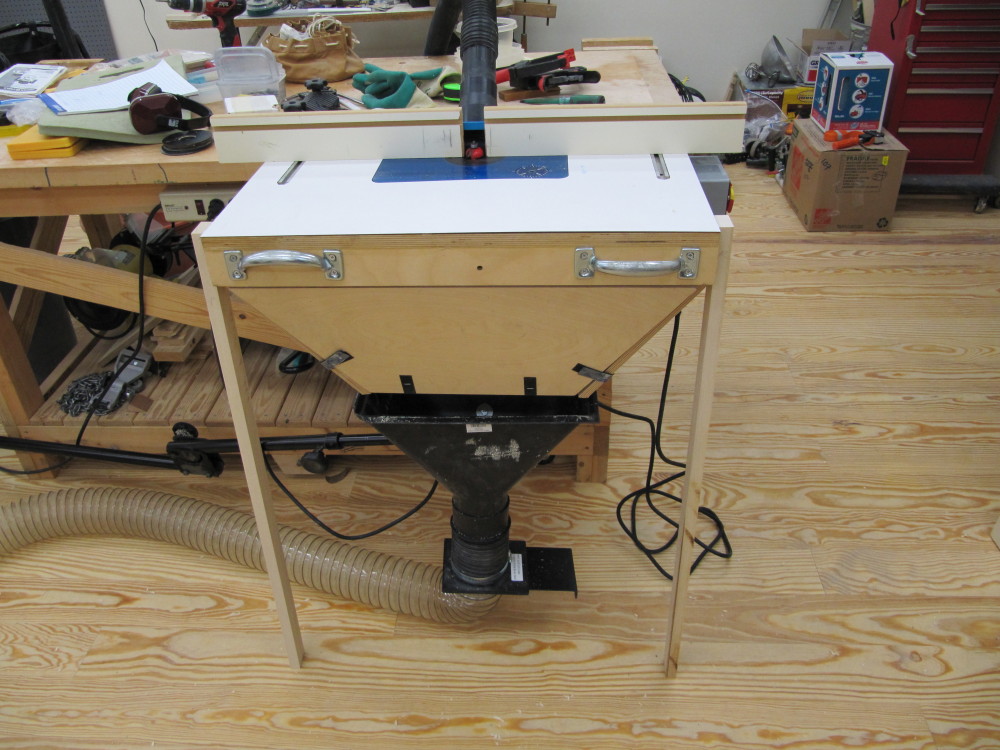
"New" Router Table. The back edge of top is bolted to a cleat that is then clamped to the Workbench. The old baffles hang down as they did before.
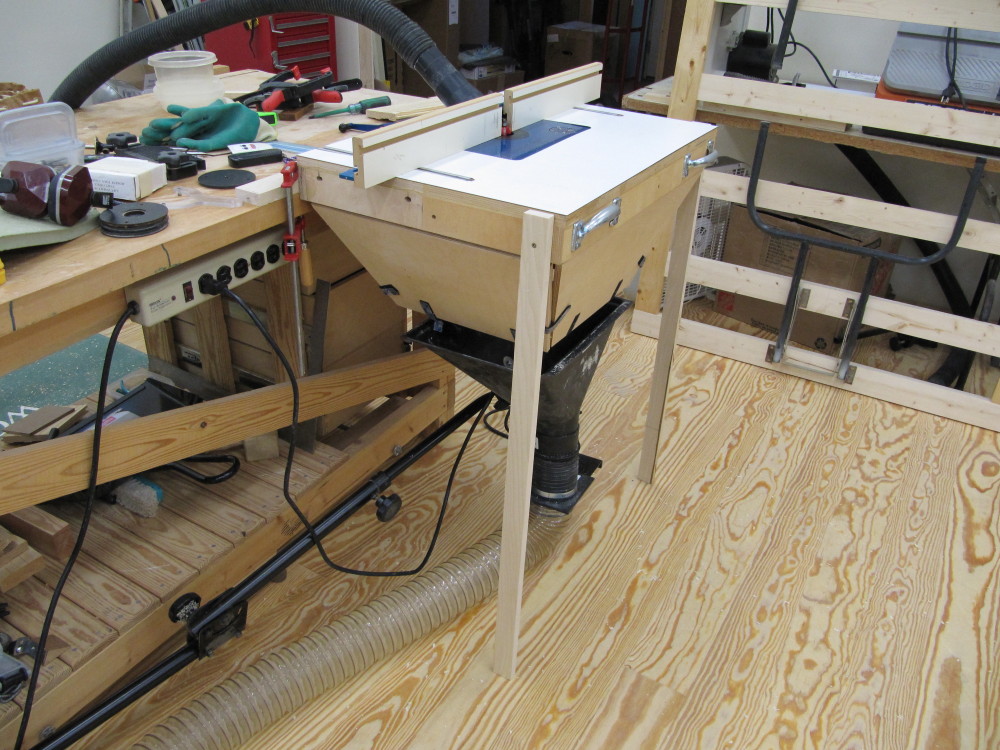
"New" Router table side view. The main difference is that the dust hood is no longer suspended from the baffles (I couldn't find the old hood) but, rather, uses my larger hood with a rather ungainly looking support arm (which is also clamped to the Workbench).
Finally, the most excellent part is that I’ve replaced my older 1 1/2 HP router motor with a new 3 1/4 HP motor. WOW! THAT makes a difference!
So, now I have a “new” Router table that can be set up fairly quickly and provides a good, stable platform for routing. I’ll replace this with a permanent setup at some point in the future, but, for now, this will work fine.
As part of completing the Workshop tool inventory, I’ve finally gotten a mortising tool. For those unfamiliar with this tool, it is a tool used to drill square holes and, when you put multiple square holes in a precise row, you get a nice rectangular hole, like this:
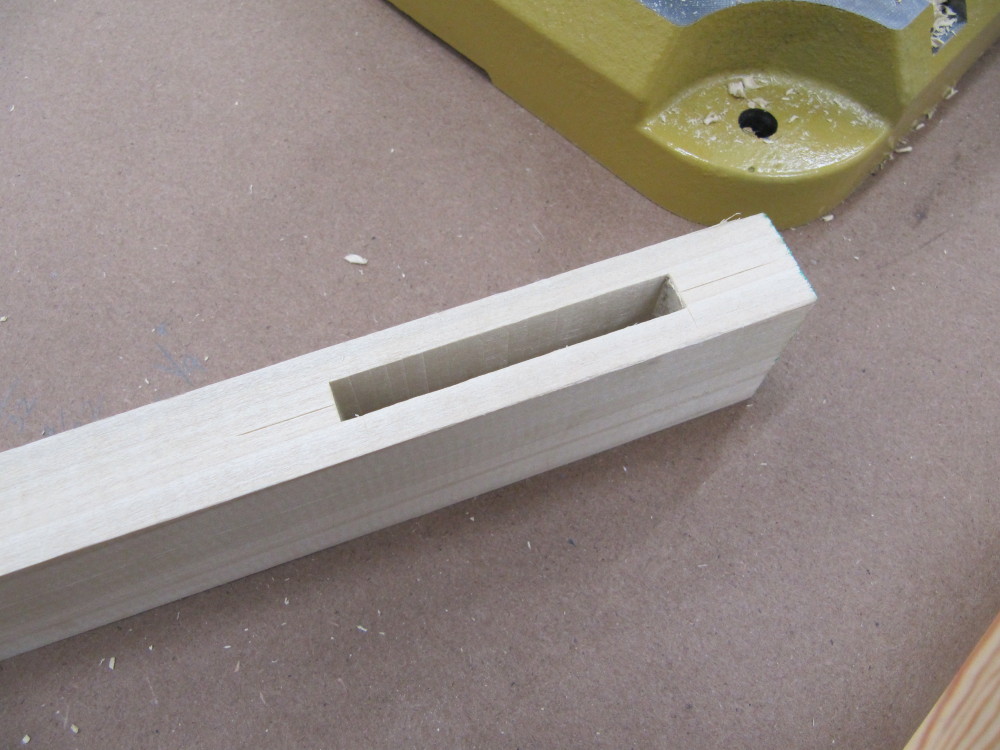
Rectangular Mortise, 5/16" x 1" deep, cut into a scrap piece of Poplar.
I tried a mortising tool years ago, but was disappointed with the results and returned the tool. It was a quality brand tool, but it didn’t cut very well – it took a lot of force to get it to drill into Cherry and, in fact, the handle shear pin broke in trying to use it. Since then I’ve learned that the Mortise Chisels that come with these tools are notoriously dull and need sharpening before you can use it – who’da guessed?
In researching for a new tool, my previous experience continued to nag at me and I decided that if I couldn’t get the best, there was no point in getting any. So, after reading several reviews, it was very clear that the only choice (for a bench top mortiser) was the Powermatic PM-701:
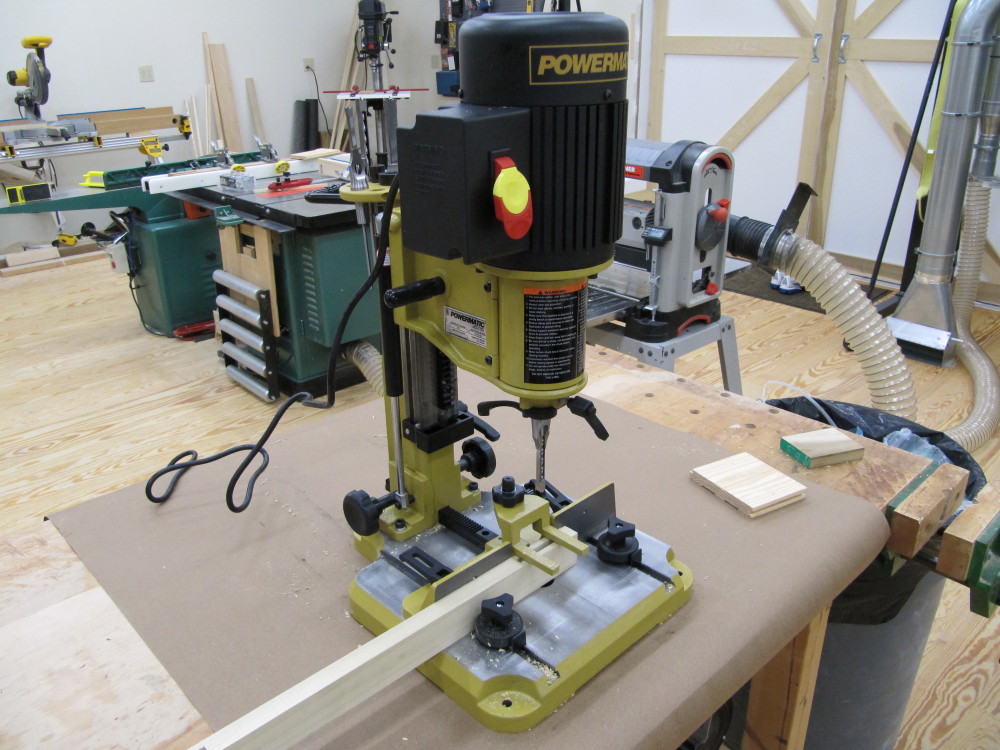
Powermatic PM-701 Benchtop Mortiser
This little baby weighs 93lbs, being mostly cast iron, with a 3/4HP motor. This machine is solid!
There are several features that really stand out on this unit.
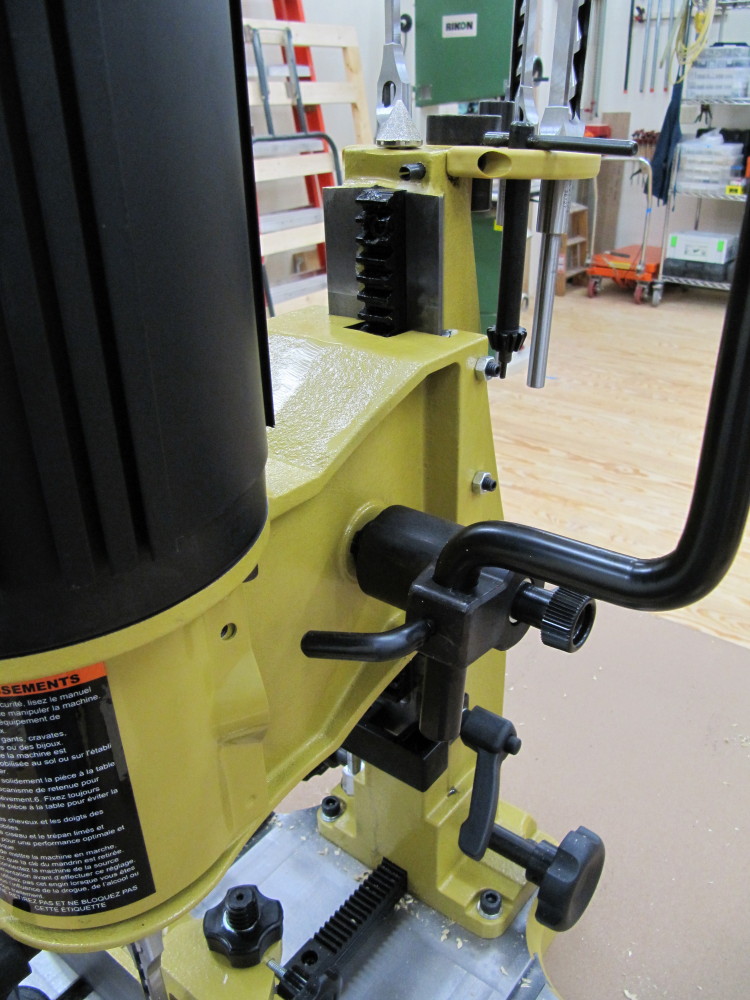
The critical part of any mortising tool. Any 'slop' in this area and you have a weak machine. With this tool you have high quality machined ways, adjustable gib (at three points) to take up any wear over time, rugged handle that can be moved for either left or right handed operation, large rack and pinion gear for moving the head up and down, and solid depth stop that reliably grips the post.
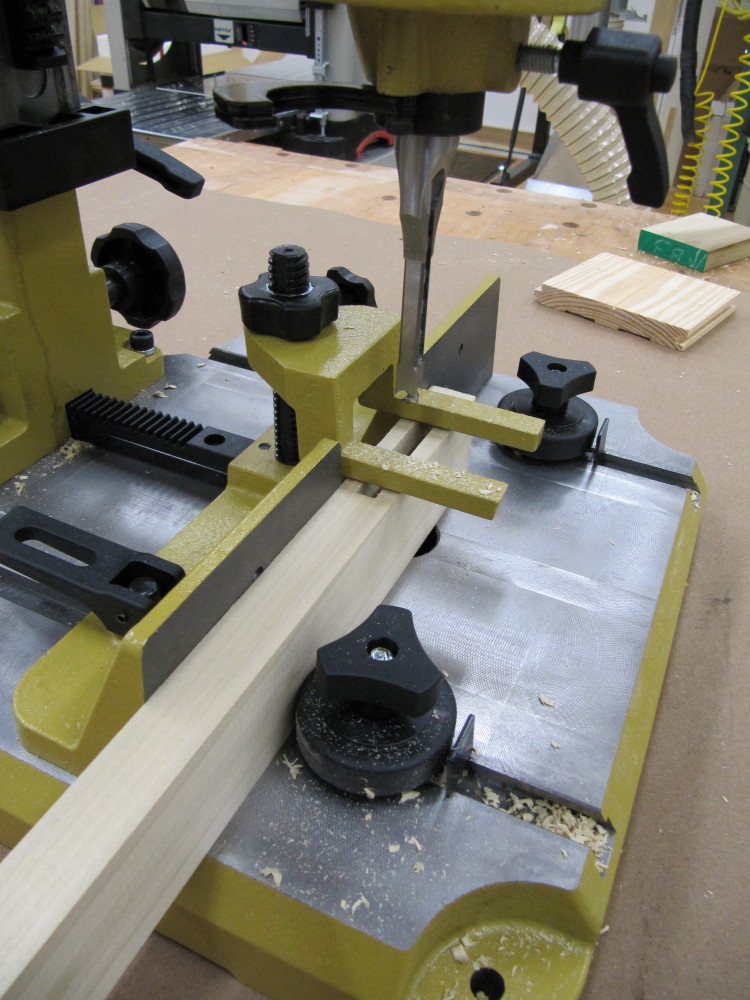
The 'working' part of the Mortiser.
This tool has a solid cast iron base with a nicely machined cast iron fence that positions smoothly and has levers to rigidly lock it into position. The tool has a unique feature for accurately and quickly installing the mortising chisel. If you look at the larger image you’ll see, just under the collet, two plates that swing in between the chisel bushing and the collet when tightening the auger drill. Then they swing out of the way to position the chisel higher giving the necessary gap between the bottom of the chisel and auger bit – no ‘guessing’ at the gap. If you’re using a large chisel you would use both plates to provide a larger gap, but with chisels 1/2″ or smaller, only one plate is used.
Another feature that I like are the adjustable rollers to keep the workpiece against the fence. Most other Mortisers, if they provide anything, have either simple blocks or finger board type of pressure points. The rollers provide a nice reference point without creating unnecessary drag.
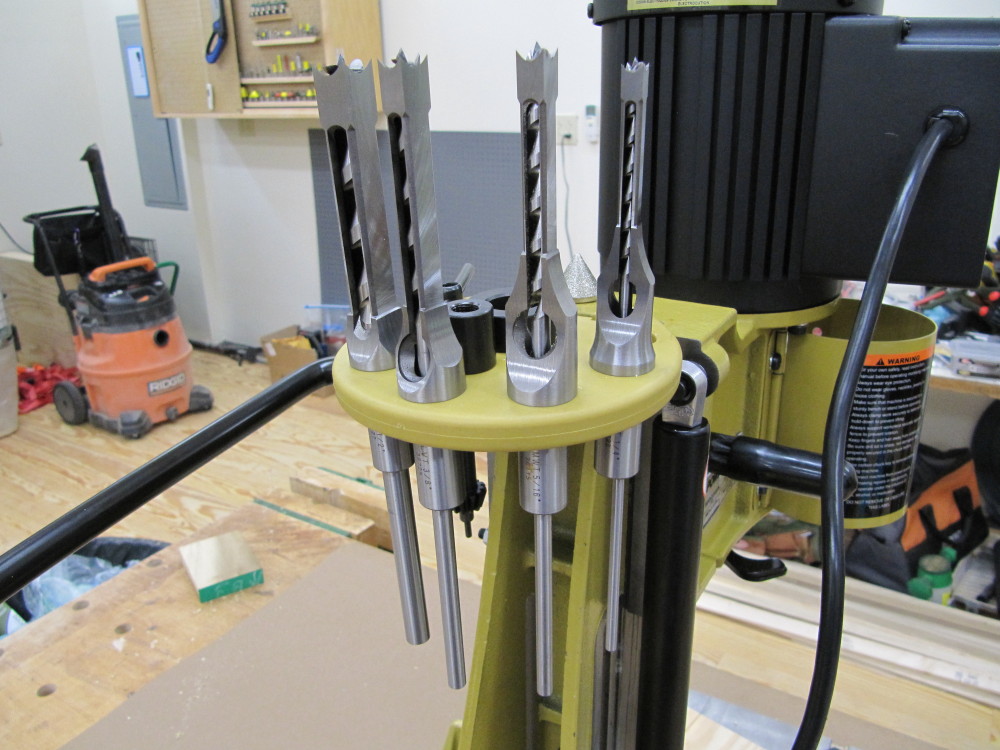
Tool Holder for Mortising Chisels, bushings, chuck key, etc.
The tool has the requisite tool holder to hold chisels, bushings, and chuck key, but adds one additional feature, a sharpening cone to keep the bits sharp. As I pointed out above, the effort to cut a clean mortise is very dependent on keeping the chisels sharp. Very handy. Finally, the mortising chisels don’t come with the tool itself, something I found odd until I realized I probably wouldn’t trust ‘included’ bits after my last experience and would probably want to select a high quality set on my own anyway – which is exactly what I did. These chisels I bought from Lee Valley tools, are made in Japan, and appear to be very high quality. I also bought Lee Valley’s sharpening cone set, which includes a medium and fine grit cone. The cone included with the tool seems to be equivalent to the medium grit cone included with the Lee Valley set.
Overall I like this machine and pleased with my purchase. And, since I have a project coming up that requires over 50 mortises, I’ll have plenty of chance to test it!
We had a doozy of a storm last night!
Several inches of rain fell, all within a half hour, made much worse by the 55 MPH wind from the South. And, wouldn’t you know, I hadn’t gotten around to weatherstrip the large loading dock door in the Workshop (and it is on the South side of the building)!
I had flooding on both floors! I was like a one armed paper hanger scurrying between floors, mopping up flooding until I finally came to the conclusion I HAD to plug up or cover the gaps. So here I was, lightning all around, rain coming down like we were gonna float an Ark, on my extension ladder (fortunately Fiberglass), covering the seams of the door with plastic. The 2nd story loft door has been covered with house wrap for at least 9 months and, wouldn’t you know, this was the worst possible conditions for the way it was layered. Who’da thunk that water would go up hill?
This morning it looks like the Workshop has survived. I had visions of the floors all buckled, but, luckily, the de-humidification from the Heat Pump and the extra fan I had blowing across the floor was enough to dry up most of the moisture so it looks like I got lucky. It is also clear what my next task is (besides cleaning up debris around the yard) – Weatherstripping!
It looks like I wasn’t so lucky after all. The section of floor that was flooded is now slightly scalloped and will probably not restore itself as the floor re-acclimates. Sigh…
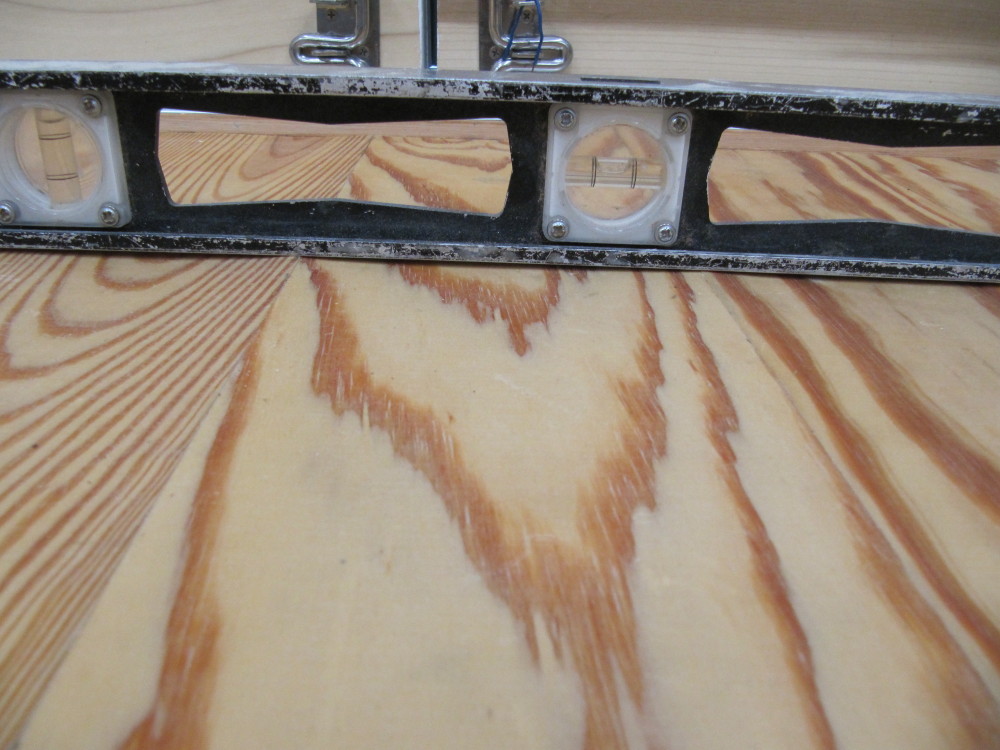
Close up of scalloped floor. You can see by the gap under the level that the edges of each board, where the water probably seeped in and stayed, are swelled upward and the middle forms a slight valley.
Yay! I’ve finally gotten the first HVAC zone in the Workshop up and running!
This is a 2 ton Mini-Split from LG (LSN240HSV) with an 18 SEER Cooling rating and 12.5 EER Heating rating. This will heat and cool the largest space, the Workshop floor. The other two rooms, the Office and Finishing room will eventually have their own 3/4 ton units, but, for the time being (since I don’t have any doors separating the rooms), the Workshop heat pump will carry the entire load.
It’s a hot day in NC today(93 F) so it’s a good day to test the system. Here is how long it took to cool down the entire Workshop (including the Office and Finishing rooms). This was with the system running in “Jet Cool” mode, the highest power setting. We’ll see how it does maintaining the temperature at a very chilly 74 degrees…

Here are some photos of the installation…
![[img src=https://tomstudwell.com/wordpress/wp-content/flagallery/workshopheatpump/thumbs/thumbs_wshp_0001.jpg]1850Transferring the compressor to the Hydraulic Lift cart.How do you single-handedly install a 95 lb compressor? Easy, simply slide it from the Workshop loading dock onto your trusty PowerWagon, power wheel it to the site, then...](https://tomstudwell.com/wordpress/wp-content/flagallery/workshopheatpump/wshp_0001.jpg)
![[img src=https://tomstudwell.com/wordpress/wp-content/flagallery/workshopheatpump/thumbs/thumbs_wshp_0002.jpg]1610Compressor moved to the Hydraulic Lift cart.You slide it on to your trusty Hydraulic Lift cart, which has been raised to the same height at the Power Wagon bed.](https://tomstudwell.com/wordpress/wp-content/flagallery/workshopheatpump/wshp_0002.jpg)
![[img src=https://tomstudwell.com/wordpress/wp-content/flagallery/workshopheatpump/thumbs/thumbs_wshp_0003.jpg]1450Compressor lowered to the lowest position.From here it's a simple matter to walk the compressor onto the base.](https://tomstudwell.com/wordpress/wp-content/flagallery/workshopheatpump/wshp_0003.jpg)
![[img src=https://tomstudwell.com/wordpress/wp-content/flagallery/workshopheatpump/thumbs/thumbs_wshp_0004.jpg]1390Compressor all positioned!Ready to connect to inside evaporator unit and to 220 volt power.](https://tomstudwell.com/wordpress/wp-content/flagallery/workshopheatpump/wshp_0004.jpg)
![[img src=https://tomstudwell.com/wordpress/wp-content/flagallery/workshopheatpump/thumbs/thumbs_wshp_0005.jpg]1360First step, after connecting with the inside unit is to pressure test the connections.Normally Dry Nitrogen is used for this step, but Nitrogen isn't as convenient as Propane and Propane, by necessity, is as dry as Nitrogen (at least dry enough). With the Propane cylinder full and sitting in the sun on a 90+ degree day, the test pressure reached over 150 PSI. Don't try this at home, kids...I found that I had two (out of four) bad connections in the refrigerant lines during the pressure test. I replaced these and, after confirming the connections were fixed, it was time to pump down the system.](https://tomstudwell.com/wordpress/wp-content/flagallery/workshopheatpump/wshp_0005.jpg)
![[img src=https://tomstudwell.com/wordpress/wp-content/flagallery/workshopheatpump/thumbs/thumbs_wshp_0006.jpg]1330Pump Down...After Pressure testing it's time to pump down the system to evacuate all gases (and any residual moisture).](https://tomstudwell.com/wordpress/wp-content/flagallery/workshopheatpump/wshp_0006.jpg)
![[img src=https://tomstudwell.com/wordpress/wp-content/flagallery/workshopheatpump/thumbs/thumbs_wshp_0007.jpg]1300500 Microns! The magic pressure.Once the system has been pumped down to this pressure, all residual moisture will have boiled off and I could seal the system and open the valves to charge the lines with refrigerant. Once this is done, we're ready to run!](https://tomstudwell.com/wordpress/wp-content/flagallery/workshopheatpump/wshp_0007.jpg)
![[img src=https://tomstudwell.com/wordpress/wp-content/flagallery/workshopheatpump/thumbs/thumbs_hp_0001.jpg]880Here it is, the finished installation.](https://tomstudwell.com/wordpress/wp-content/flagallery/workshopheatpump/hp_0001.jpg)