Sheet Goods Cutting Table

As my second project in my new Workshop, I’ve built a Sheet Goods Cutting Table.  I saw this concept mentioned in a Woodworking forum (unfortunately I haven’t been able to find it to provide proper citation – I’ll update when I find it) when I was considering building or buying a panel cutter.

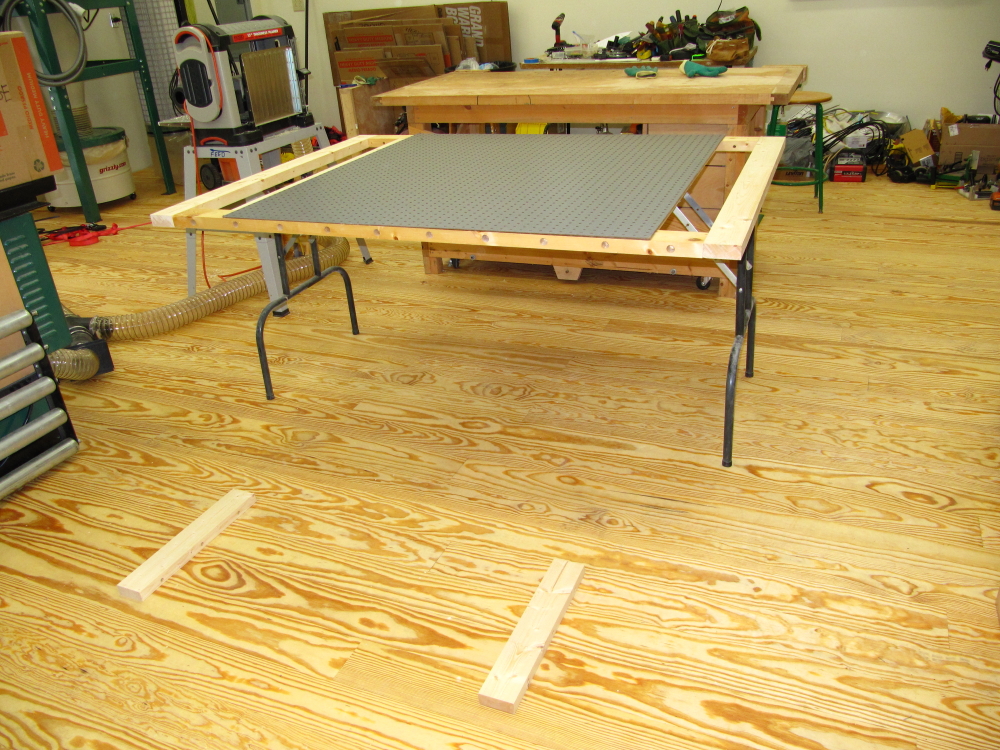
The idea is that the table is made to be sacrificial, you clamp your sheet good (plywood, paneling, etc.) to the top, clamp your circular saw guide to the sheet, and cut through the sheet slightly into the table top.  The top will get chewed up after a while, but should remain planar and usable for a long time since you only make shallow cuts into the table.

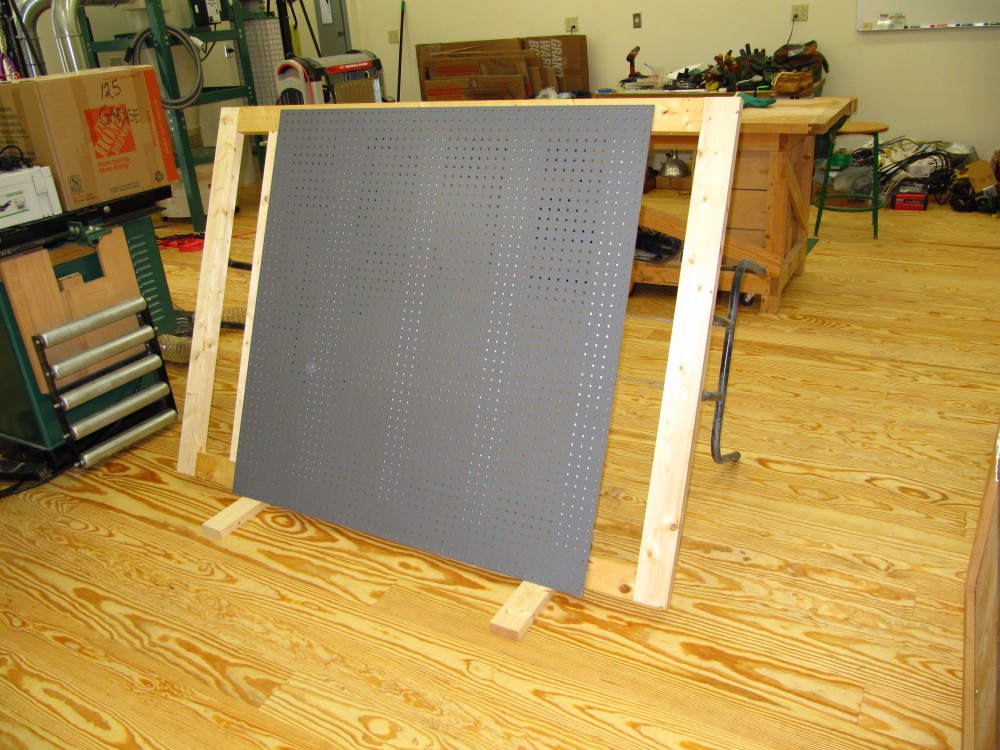
The real beauty of the concept, however, is how you load the table.  Rather than trying to lift a heavy piece of plywood onto the table, you tip the table onto its side, placing its edge on a couple of 2x4s on the floor.  You then carry the sheet to the table, carrying it so it’s perpendicular to the floor, and place its edge on the 2x4s as well.  Then, gently leaning the sheet into the table, the sheet and table are stable and you can easily reach under the edge of the sheet (lifted up by the 2x4s) and literally roll the sheet and the table together until the table is upright.  The weight decreases quickly as the table become more upright and the stable legs keep the sheet from shifting while you lift. Easy peasy!

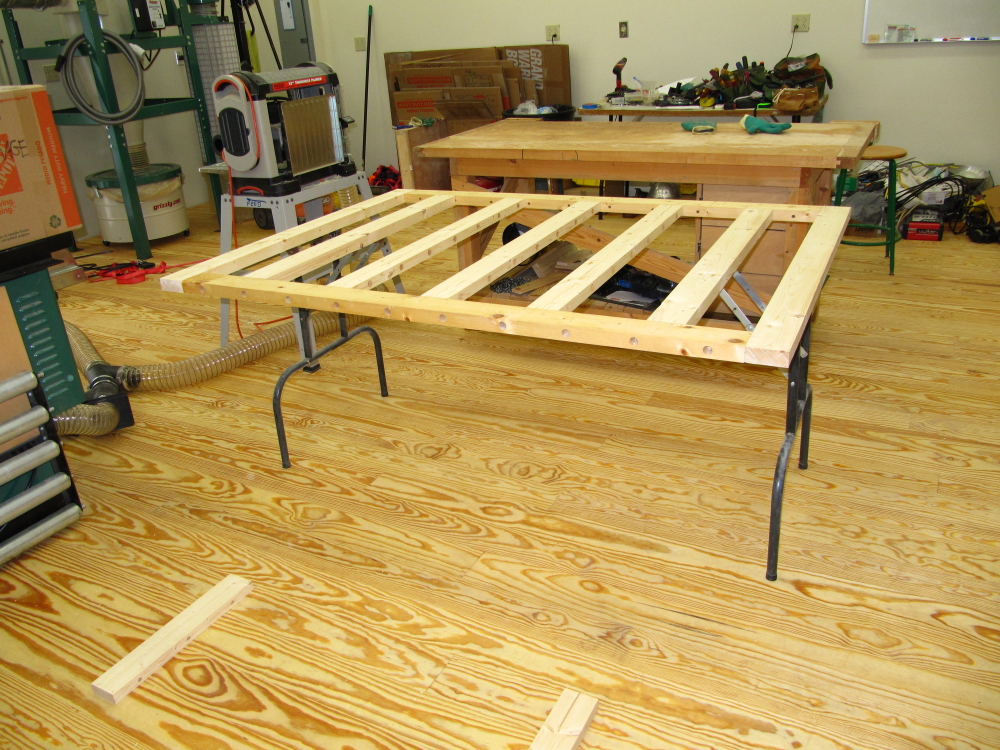
Here’s the table…

The pegboard was the only sheet I had on hand to demo the table, but, given the thin flimsy pegboard you get these days, the table comes in handy for managing this as well as heavy sheets.  In fact, the first application of this table will be cutting up some FRP (Fiberglass Reinforced Plastic) sheets which are 4×8 feet yet only 0.090″ thick – very floppy and hard to manage.  I’ll be using this material on the Main Workshop door.

Another feature of this table is the open top.  When you’re cutting sheet material narrower than a solid top table it is very hard to clamp the piece or any cutting guides to the piece.  With this design there are always some nearby opening in which a clamp can be inserted.  Just be careful where you place your tools…

The construction is easy (if you have a Festool Domino).  I used scrapped 2x4s that had outlived their usefulness as cauls (note the holes where I inserted threaded rods to clamp the cauls together).  These were then ‘unbowed’ and ‘untwisted’, squared up, cut to size, and floating tenons were added to hold the pieces in alignment and give it strength without screws (not good to cut through screws with your circular saw) – 56 mortises in all.

The most difficult task was clearing off the Workbench so that I could assemble the 60 x 48 inch structure.

Finally, the legs on this table have a VERRRRY long history with me.  These legs were salvaged from a work table I built when I first started my own Engineering Consulting business – in 1980…   I still have a few of those work tables left.  :-)

The cutting table will eventually find its permanent home in the loft where I’ll store my sheet goods.  I’ll rough cut in the loft so that I only need to move small pieces down to the Workshop.
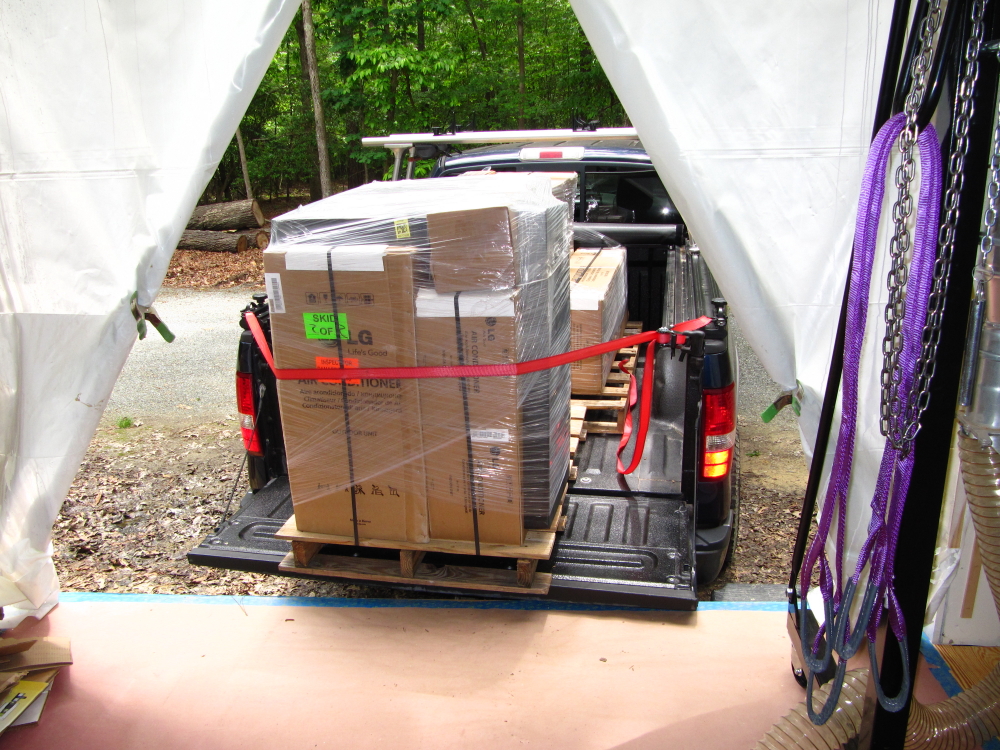


HVAC has arrived!

The 3 1/2 tons of Heat Pump equipment arrived today!   I probably won’t install right away since, as you can see below, I still have to build the doors for the Workshop loading bay.

The Heat Pumps are LG Mini Split systems.  The Workshop gets its own 2 ton unit (21 SEER) and the Office and Finishing rooms each have a 3/4 ton unit coupled to a single compressor (18.9 SEER).  I’ll have more when I install these.

Click to view larger image.

Two pallets of HVAC equipment... PS: I didn't drive on the highway like this. I just used my pickup to shuttle the equipment from the delivery truck.

Dust Collection, it’s a wonderful thing!

Now that I have power to the Workshop and am getting ready to do ‘real’ work, the obvious task is to take care of the dust and wood chips I hope to be making soon!

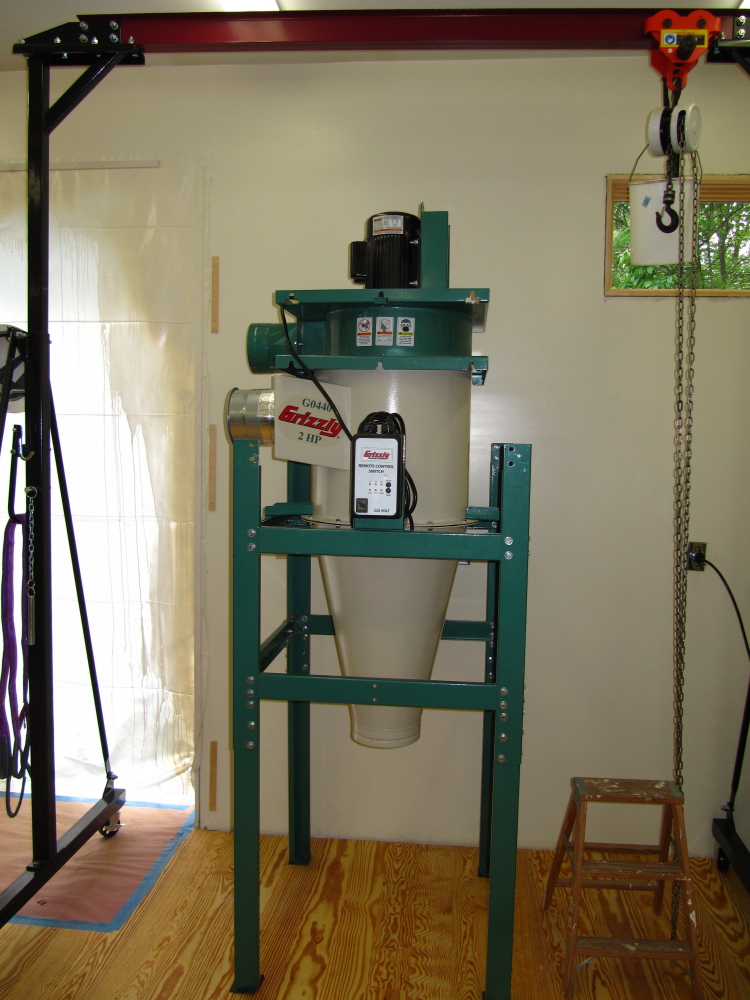
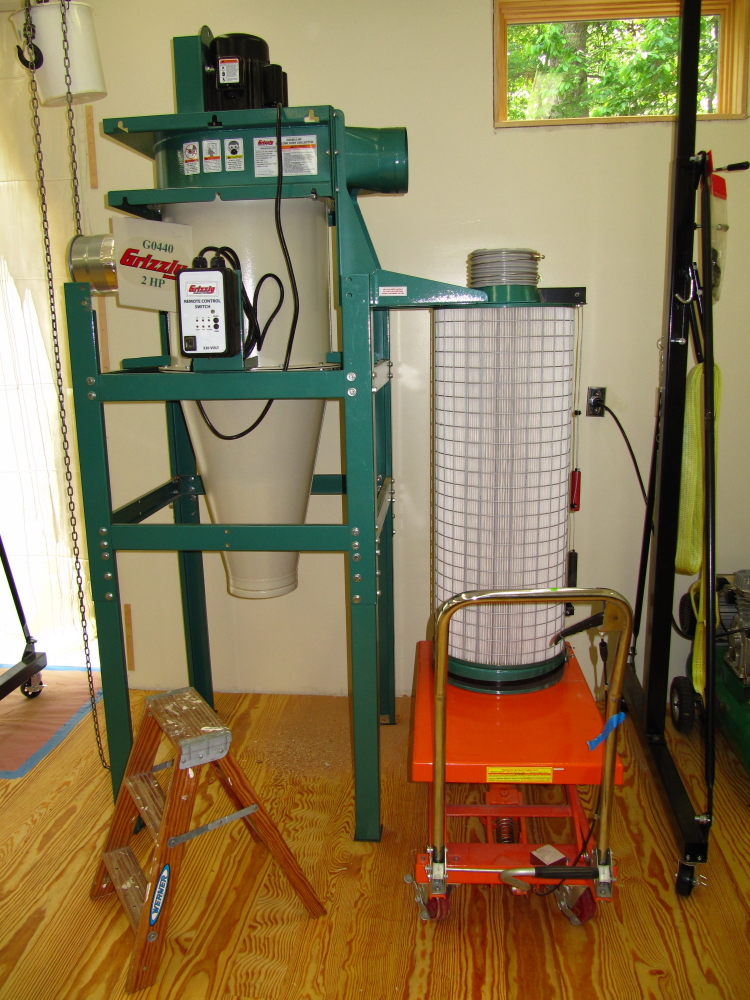
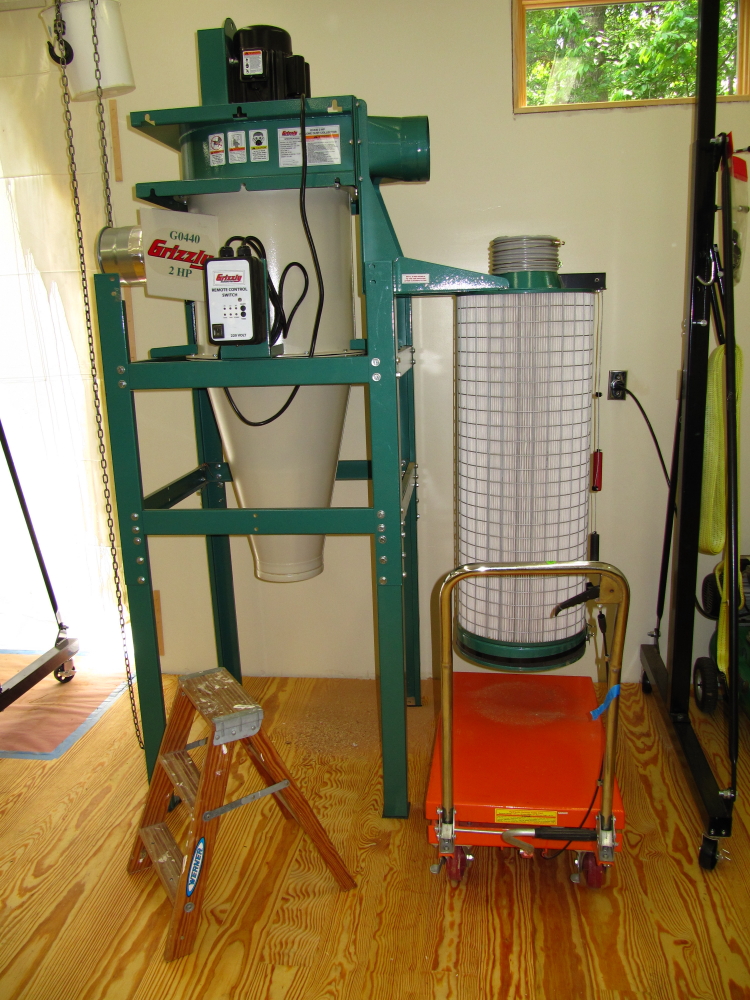
Using the Gantry Crane I was able to get the Dust Collection (DC) unit upright and ready to use.   But the plan calls for the unit to be modified so that the fine dust filter is opposite the intake (different than the setup I had in TX).   I used the Gantry Crane to separate the top section, rotate it 180 degrees, and install the filter on the opposite side.  Note how the Hydraulic Cart conveniently held the DC Filter in place while I attached it to the hanging brackets.  The Filter isn’t heavy, but it is awkward and, with the Hydraulic Cart, it was a snap to hold into position while I tightened the bolts.

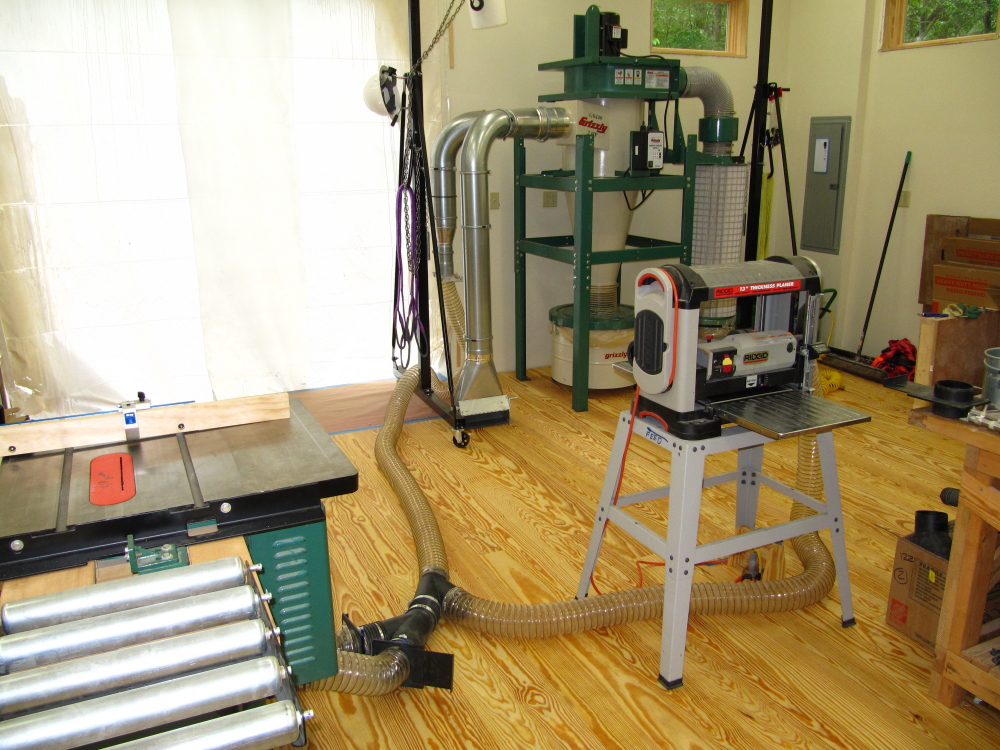
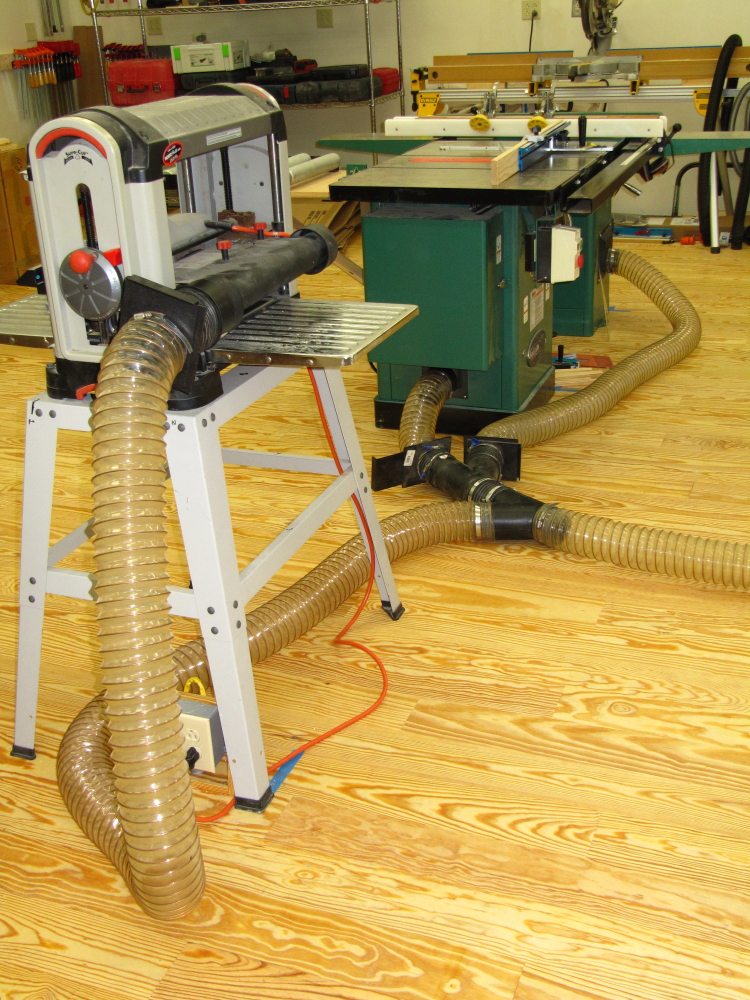
Same goes for the ducting and, while the setup is ‘suboptimal’ (I’ll be installing the permanent ducting under the flooring), the Quick Connect ducting from Nordfab was extremely easy to setup a useful connection to my three main ‘debris’ makers (Thickness Planer, Jointer, and Table Saw) AND still provide a branch for the Floor Sweep.

How to add a Floor Mounted Receptable

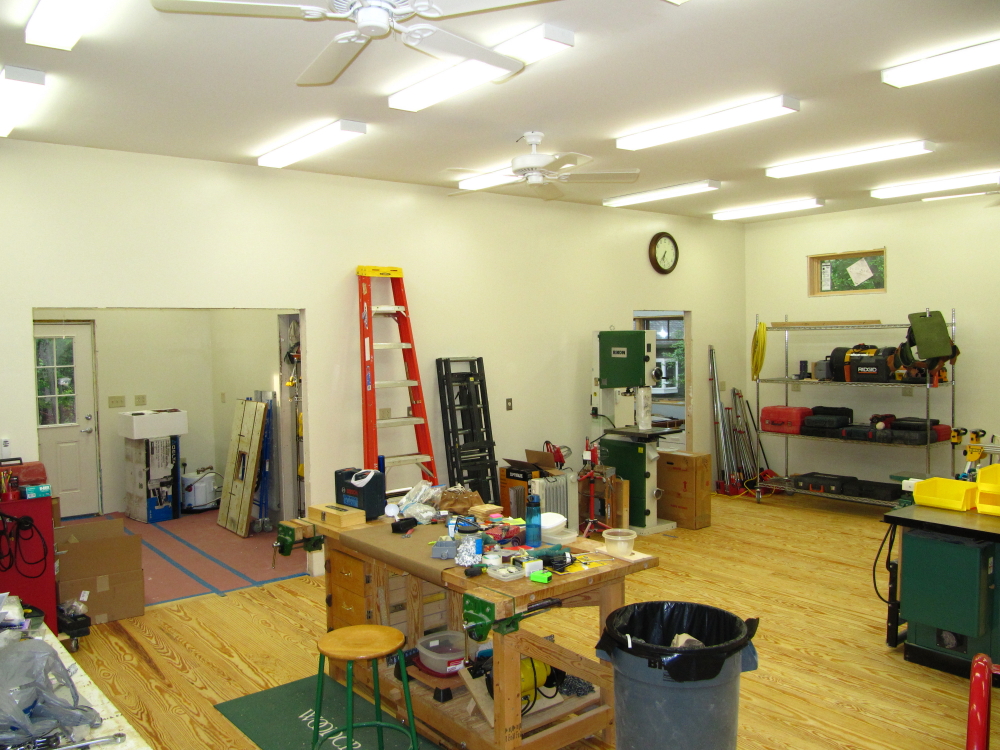
With my Woodworking equipment now moved into the shop and positioned in their permanent locations, it’s time to add the 120V and 220V receptacles to the middle of the floor.  I had planned to temporarily use extension cords, connected to the surrounding wall outlets until I was ‘settled in’, but the 220V extension cord hasn’t been unpacked yet so…

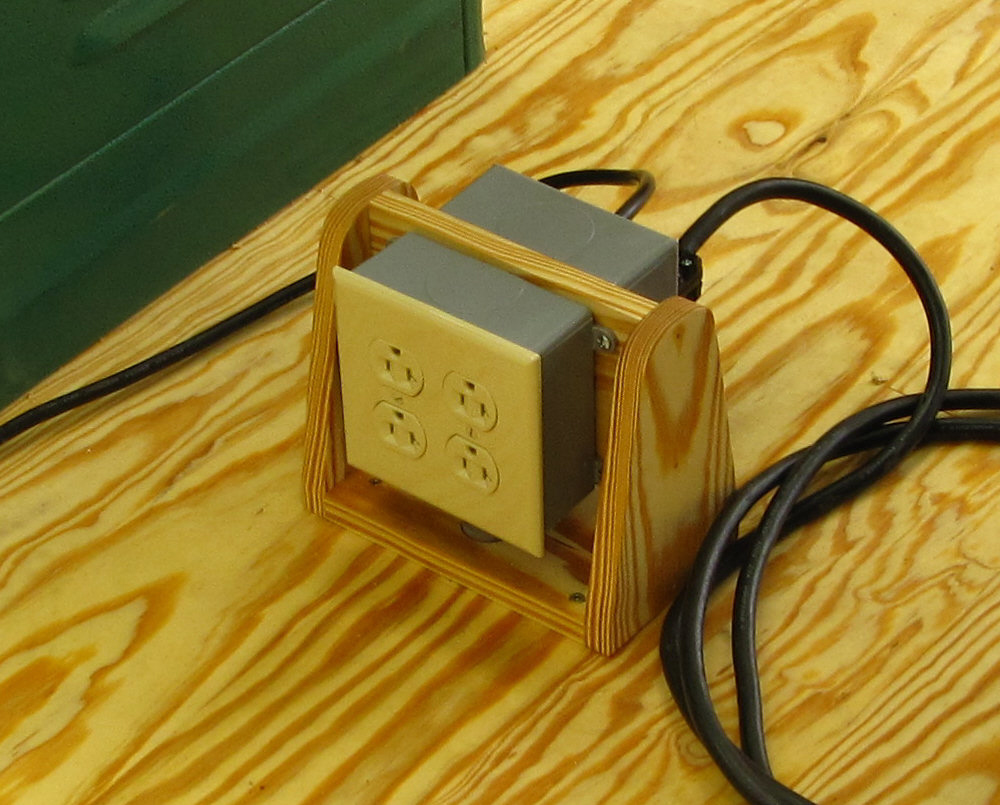
Time to make the floor mounted receptacle support.

Now I had lots of choices for mounting the receptacle boxes:

  • I could go utilitarian and use angle iron – Too ugly and tough to get rid of sharp edges that tend to wreck shins.
  • I could use surface mount boxes – too expensive and I’d have to cut large holes in my nice new floor.
  • I could mount the electrical boxes directly on to the floor – hmmm, sort of ugly and takes up a lot of floor space.  Easiest to do, however.
  • Or… being a woodworker, I could make some out of wood!

Yes, this last one appealed to me.  However, I soon found out that, with the shop only partially unpacked, it was a very interesting case of using tools and techniques modified by ‘what was available’.

The choice of wood was easy, the task didn’t warrant an expensive wood and I have plenty of flooring cutoffs I had saved.  This would complement the flooring and ya can’t beat the price!

Task 1 was to use my thickness planer to mill off the ridges on the underside of the flooring.  While the thickness planer is one of the tools that requires a floor mounted receptacle, it runs on 120V so an extension cord worked just fine.  The planer stand hadn’t been assembled yet, but I used my trusty hydraulic lift cart as a temporary stand.  This task was completed in short order yielding 8 pieces of 5/8″ uniform thickness.

The next step was to rip these to remove the tongue and groove.  Since the Table Saw required the 220V Extension cord, it was time to get my 18″ bandsaw back into action.  This made sense anyway since the ‘design’ called for using the BS to cut some curves.

Getting the BS ready took a little more time than expected.  Sitting idle for more than ten months apparently allowed the saw dust in the blade guide bearings to ‘settle in’ an some of the bearings wouldn’t turn at all while the remaining turned with some effort.   Fortunately, soaking in Mineral Spirits cleaned out the gum and the saw dust and I was able to recover these.

Then I was reminded of a ‘fix’ I had installed in the BS when I first got it – the top wheel bracket fit too loosely in its guide and I had installed some shims to keep the wheel from wobbling.  I guess moving the equipment dislodged the shims and I had to ‘re-invent’ the ‘fix’ before I could use the saw. Finally, after much searching, I was unable to locate the guide for the BS fence.  Kerry serendipitously found a cutting guide clamp that fit well enough on the saw to provide a reliable and relatively easy to use fence.

So, within minutes (after hours of messing around, looking for stuff) I had 8 uniformly wide boards, ready for final dimensioning.  4 of the boards were merely cut to length on my Miter saw – a key tool all along.

The remaining 4 boards had to be cut with a matched curved profile. This was the fun part.  Finally a bit of woodworking…

I rough cut the first one using a template I printed from my Sketchup model of the mount.  I simply taped a cut out of the paper template to the board.   Once I had the rough cut, I used my Oscillating Edge Belt/Spindle Sander to smooth and even the edges and curves.  I was pleased that I hadn’t lost my touch and was able to finish the curves easily.

Using this first board as the template, I marked the remaining three boards and rough cut these on the BS.  At this point I would have normally used the first board as a routing pattern on my router table and gotten exact matches on all four pieces.  However, since the ‘old’ router table had been mounted on the wing of the Table Saw and was removed to tuck a portion of the jointer under the TS wing AND the ‘new’ router table hasn’t been built yet…   I decided to try my skill at matching the pieces using the sander.  Again, with a light touch, taking my time, I was able to get a good match between two pairs of boards and I was ready to assemble and, finally, get power to the Table Saw.

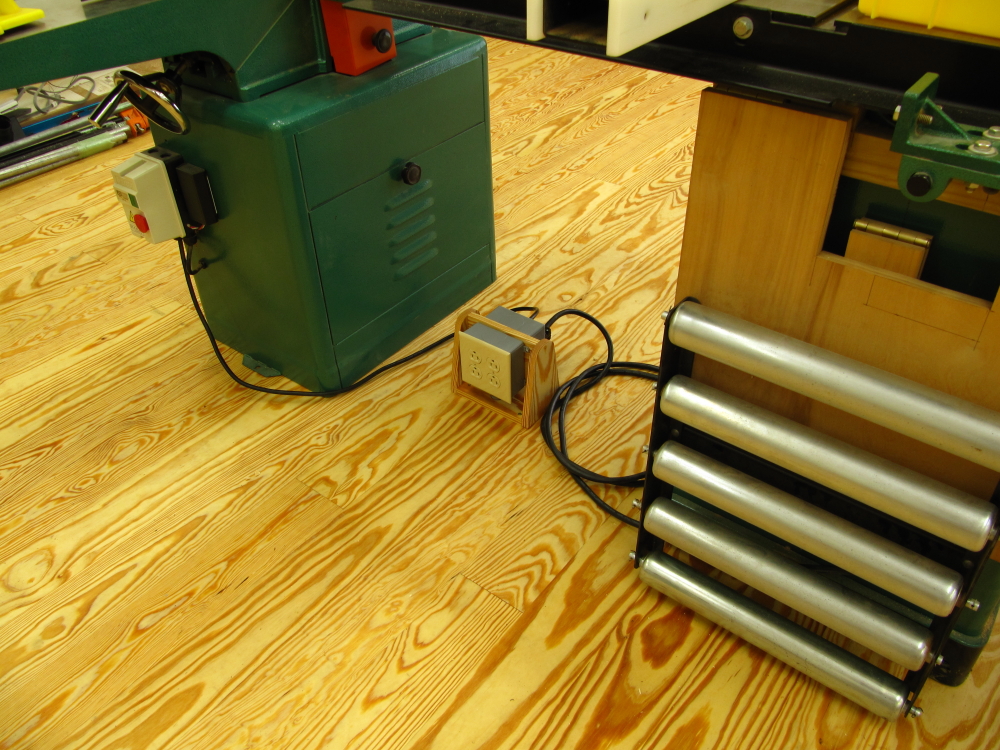
So here are the results…

Now I have power to the Jointer and Table Saw so that I can easily and accurately rip those boards I need to make the receptacle mount… Oh wait, that’s already done.  Hmmmm, maybe I’ll rip the last piece of flooring for the office…

Workshop Power!

YAY! Yippee!  Doing Cartwheels around the Workshop (in my head, anyway)!

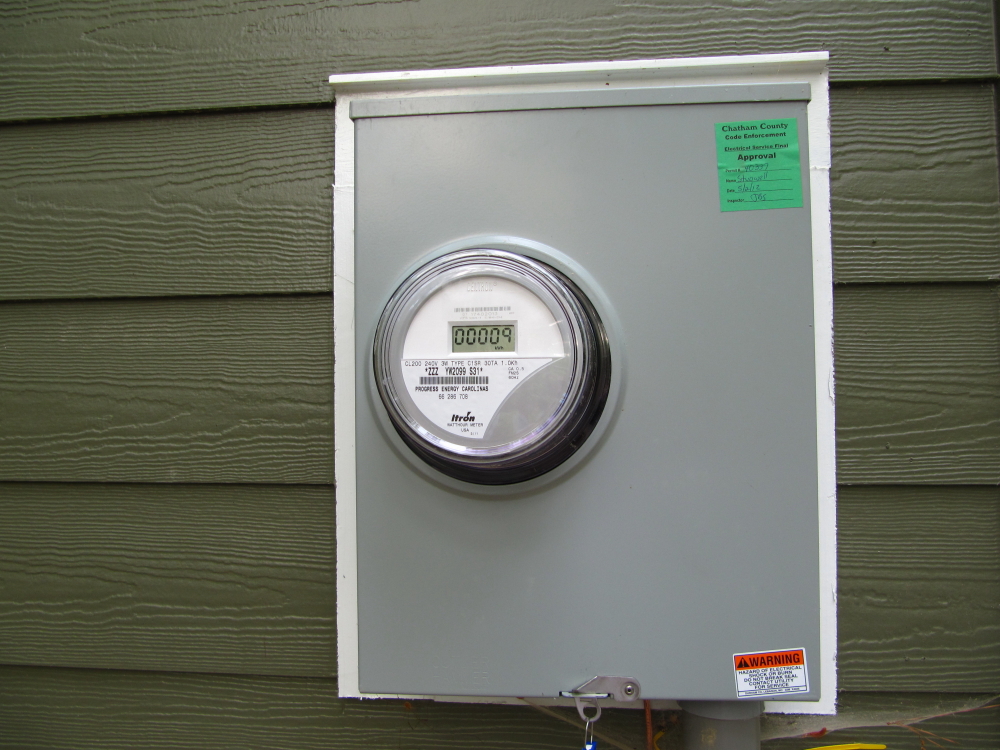
We’ve got power into the Workshop!  Lights!  Fans!  Compressor! Hot Water in the Bathroom!  Woo Hoo!

WordPress theme: Kippis 1.12